In 2025, Comet made solid progress despite a challenging environment. While the semiconductor industry showed early signs of recovery, geopolitical tensions, tariffs, and trade restrictions continued to pressure global markets and supply chains. We remained focused on positioning Comet for future growth. Through disciplined cost management and prudent capital deployment, we continued to invest in the foundations of sustainable, long-term value.
“We made targeted investments to accelerate growth while driving efficiency across the business.”
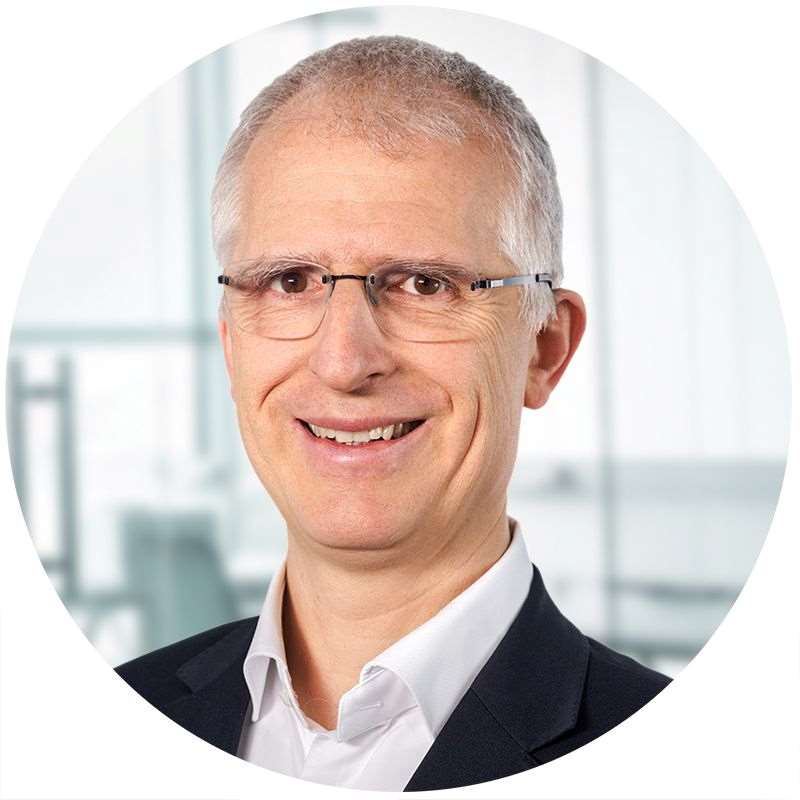
Christian Witt
Chief Financial Officer
2025: A Year of Progress
In 2025, semiconductor investment was driven primarily by AI-related applications, including advanced logic and data-center infrastructure, while traditional volume markets such as automotive, smartphones, and PCs remained subdued. Tight memory supply supported rising prices throughout the year. Chipmakers focused mainly on equipment upgrades rather than significant capacity expansion. Momentum improved toward the end of the year, supported by new fab announcements and by confirmed or increased spending for wafer fabrication equipment (WFE).
Traditional industrial markets showed limited growth, particularly in Europe, reflecting soft economic conditions. Overall, 2025 marked a transition year, characterized by AI-led demand, selective investment, and improving visibility toward the end of the period.
In this environment, Comet continued to focus on one of its key strategic initiatives: expansion in Asia, currently centered on the establishment of a new facility in Penang, Malaysia. The project made excellent progress in 2025 and remains on schedule and within budget, with completion expected in late 2026. This facility will play a central role in supporting our long-term growth while further diversifying our global manufacturing footprint.
Financially, 2025 was not a year of full recovery. Our results reflect the impact of macroeconomic headwinds and unfavorable currency movements. While revenue increased compared with the previous year, margins were lower.
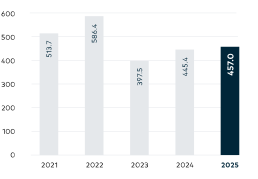
Net sales in CHF million
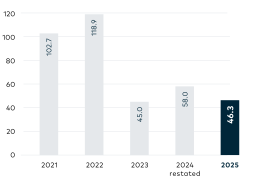
EBITDA in CHF million
In this business environment, Comet achieved net sales growth of 2.6% year over year in 2025 to CHF 457.0 million. Operating earnings at EBITDA level were lower, contracting to a margin of 10.1% from 13.0% in the previous year, reflecting unfavorable product and regional mix effects as well as adverse exchange rate developments. Net income decreased by 62.8% to CHF 12.2 million, translating to earnings of CHF 1.57 per share.
Higher capital expenditures for the new Penang buildingled to a reduced, positive free cash flow of CHF 8.5 million, compared to CHF 41.4 million in fiscal year 2024. The Group’s equity ratio of 61.6% and a debt factor of minus 0.1 underscore Comet’s robust financial position and continued balance sheet strength.
Comet Group key consolidated financial results
In thousands of CHF
2025
2024
restated
2023
2022
2021
Net sales
457,044
445,362
397,453
586,395
513,721
Operating income
24,556
35,861
24,978
98,975
84,085
In % of net sales
5.4%
8.1%
6.3%
16.9%
16.4%
EBITDA
46,335
58,011
44,996
118,913
102,749
In % of net sales
10.1%
13.0%
11.3%
20.3%
20.0%
Net income
12,208
32,779
15,388
78,109
67,437
In % of net sales
2.7%
7.4%
3.9%
13.3%
13.1%
Free cash flow1
8,502
41,414
(584)
42,173
57,767
In % of net sales
1.9%
9.3%
(0.1%)
7.2%
11.2%
Total assets
500,920
529,148
473,578
556,801
482,341
Shareholders' equity
308,769
323,098
296,092
331,532
274,981
In % of total assets
61.6%
61.1%
62.5%
59.5%
57.0%
Number of employees (year-end)
Switzerland
705
690
586
647
565
International
1,127
1,120
991
1,116
1,006
Total
1,832
1,810
1,577
1,763
1,571
1Sum of net cash provided by operating activities and net cash (used in) investing activities, as per consolidated statement of cash flows.
Favorable growth outlook driven by booming memory demand
Comet’s long-term growth outlook remains highly attractive as the semiconductor industry enters a sustained expansion phase driven by exceptional demand for memory chips. The rapid build-out of DRAM and NAND production capacity, fueled by structural AI demand and advanced computing workloads, is driving a strong upcycle in wafer fabrication equipment spending. Ongoing technology transitions, increasing advanced-node investments, and the global push for technological sovereignty further reinforce elevated WFE demand, positioning the company to benefit from a prolonged period of industry growth while continuing its disciplined investment approach.
Divisions: Solid semiconductor-driven growth, tempered by currency headwinds
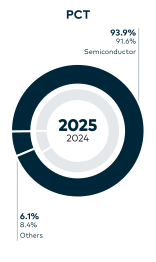
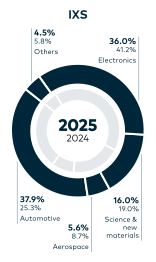
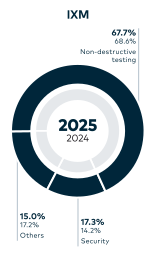
The Plasma Control Technologies (PCT) division remained the largest contributor to Group sales, achieving net sales growth of 3.9% to CHF 257.1 million (previous year: CHF 247.4 million). By contrast, the X-Ray Systems (IXS) division’s net sales were below the previous year’s level, with a decline of 4.4% to CHF 110.8 million from CHF 115.9 million in the year before. Meanwhile, the X-Ray Modules (IXM) division achieved net sales of CHF 99.1 million, an increase of 4.8% compared to the previous year (CHF 94.6 million). Exchange rate movements affected all divisions and reduced Group net sales by a total of CHF 20.8 million or 4.7%.
Lower profitability due to mix effects and exchange rates
EBITDA margin development varied across the divisions. The largest division, PCT, recorded a margin decline, mainly due to challenging product and regional mix effects as well as foreign exchange movements. In IXS, we made substantial investments related to the strategic repositioning of the business unit toward the semiconductor industry, which are also reflected in the 2025 profitability. IXM, however, improved its margin, supported by new product launches and strict cost discipline. Overall, the Group achieved an EBITDA margin of 10.1%, compared with 13.0% in 2024.
The Group’s net income of CHF 12.2 million was 62.8% below the year-earlier figure of CHF 32.8 million. Return on capital employed (ROCE) decreased to 5.2% (previous year: 9.7%).
Plasma Control Technologies (PCT), the Group’s largest division and the most exposed to the semiconductor industry, was unable to maintain the prior-year margin. Amid a mixed business environment, the division’s margin decline was driven primarily by the rapid weakening of the U.S. dollar against the Swiss franc, which weighed on operating margins. In addition, demand temporarily shifted toward lower-margin products and regions that traditionally exhibit lower profitability. EBITDA for the division decreased by 19.8% year over year to CHF 40.4 million, with the EBITDA margin contracting from 20.4% to 15.7%.
In the Industrial X-Ray Systems (IXS) division, the strategic focus on the semiconductor industry continued to advance, supported by the introduction of a new inspection system dedicated to this market. Initial commercial traction was achieved with early system sales; however, this momentum was not yet sufficient to fully compensate for significant investments in product development and the decline in net sales resulting from subdued investment activity across several traditional end markets. Therefore, the division reported a negative margin for the period. EBITDA for IXS was a deficit of CHF 7.5 million, compared to a deficit of CHF 4.3 million in 2024, with the EBITDA margin declining to a negative 6.8% from a negative 3.7% one year earlier.
Meanwhile, the Industrial X-Ray Modules (IXM) achieved growth in both net sales and margin, although demand in traditional markets remained subdued. The division benefited from new products introduced progressively over recent years, which are gaining increasing acceptance in new markets such as semiconductor and battery applications, as well as from strong cost discipline. These factors helped to more than offset adverse developments related to tariffs. With EBITDA of CHF 15.8 million, the division was able to increase this earnings metric by 8.3% from the year-ago figure of CHF 14.6 million. The EBITDA margin improved from 15.4% in the previous year to 15.9% in 2025.
While the demand environment improved over the course of 2025, operating cash flow was impacted by a weaker operating result and higher capex, mainly related to the investments in the new production building in Malaysia. Free cash flow was therefore lower at CHF 8.5 million, compared with CHF 41.4 million in the prior year.
Sales by market
Dividend
At the Annual Shareholder Meeting on April 14, 2026, the Board of Directors will propose a dividend of CHF 0.50 per share (prior year: CHF 1.50). This represents a distribution of 31.9% of the Group’s net income (previous year: 35.6%).